i2imca Machine Control 4

Last weekend I had the opportunity to take part in the final course of four with the i2i Motorcycle Academy. Each of the four courses uses techniques from road, off-road, supermoto and track motorcycle riding to teach participants how to work with their machine and to challenge the preconceptions we all have about what can be done and what can’t be done with a motorcycle.

Known as MC1, MC2, MC3 and MC4 the courses build on each other to challenge you and your own machine, and also off-road and supermoto machines provided by i2imca. But a key technique of the instructors is to keep you in your comfort zone while doing this, so that at no time should you be put in danger of a panic situation. And another of their key principles is that they never demonstrate techniques that they haven’t (or won’t) show you how to do in their course.

MC1 and MC3 are carried out on your own motorcycle and I did the two over a single weekend last year. This year I had opportunity to complete the other two courses, which also happen to use machines supplied by i2imca. This year in April I was introduced to off-road in MC2 and supermoto in MC4. As you can probably guess, all of the courses are conducted off public roads – this gives the instructors a sterile environment to take participants through the drills that build on each other through the course. Last year MC1 and MC3 took place at Tockwith, on an old WW2 airfield, MC2 was on an off-road track near Thirsk and MC4 took place on a section of the airfield at Rufforth.

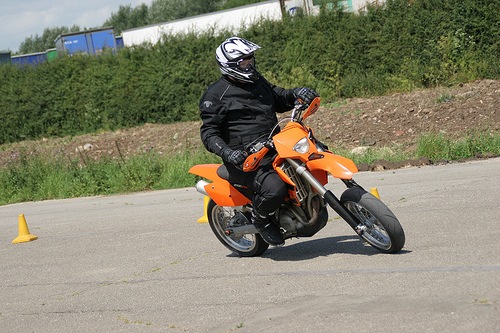
MC4 is billed as the course to “develop very advanced skills” and covers the extremes as they relate to braking, cornering, acceleration and cornering. To do this you bring in things learned in the earlier courses, and then try to figure out how they apply to a supermoto.

3690185460_6ce5d0c213

If you’re not familiar with Supermoto, basically the bikes are motocross machines with different wheels and with the front brake changed. Road wheels and tyres are put on the machine, and a larger front brake added to be able to use the increased grip on the front wheel.

Tom Killeen, director at i2imca, started the day by getting us kitted up in the mixture of styles that comes with supermoto – motocross boots and helmet, and our own road kit for jacket, pants and gloves. Then we had a look at the bike to figure out how to ride it. Is it a road bike or an off-road bike? It has the ground clearance of a motocross bike, which compared to road bike is huge. To illustrate a point, like he does throughout the course, Tom took one of the parked KTMs and showed us how far it could be tipped over which seemed to be almost horizontal. This began to show how suited supermoto machines are to this type of course – with their excellent ground clearance and long travel suspension they are ideally suited to exploring the “extremes” of machine control.

We then had opportunity to learn the course which had been laid out in cones on the tarmac – a series of turns, jinks and even a double back had been added to make us apply the techniques we would learn – and then they added an off-road section in the afternoon! But even that was a lesson, as one group goes out the next group can watch and learn – where are they sitting? Do they move around? How do they move?

Throughout the day the course takes one “story” or preconception at a time and challenges it or illustrates it. For instance, what happens under extreme braking? Does the front wheel skid? What happens with weight transfer? To show how much grip is available we practiced the technique from MC3, which combines use of the gyroscopic effect of the wheels with managing weight transfer to maximise grip and stability. Then we took it to the extreme by changing the braking technique slightly and we were doing stoppies! This went to show how much grip we had, and then we built on that by using the weight transfer of our bodies forward or back to work with acceleration or braking.

And other important techniques built on these principles of using body weight transfer to work with the other forces and capabilities of the machine to rewrite the stories and misconceptions that come to us from all sorts of places. Countersteering was used, smoothness was emphasised and the inherent  stability of a moving motorcycle reinforced.

For me – a relative novice and the first time on a supermoto, it was a lot to take in, but Tom and his fellow instructors take things step by step and emphasise the basics – there is only so much you can take in at a time but these build and build and help all of us to be better and safer riders who can ride our machines better.

I thoroughly recommend the series of courses which fill a gap in the provision of machine control training for motorcycles, there are still riders who have ridden and ride thousands of miles a year that do not know how a motorcycle turns or that they can do anything about it apart from “lean” or others who struggle with braking hard. If you are willing to learn (and unlearn) then you will take a lot away from these courses.

Scottish Supermoto

Popped along to see one of the EDAM members racing a DRZ at the Scottish Supermoto place in Crail. Got there a bit late, and the batteries ran out in the big camera, but there are one or two pics in there that turned out really well. There are also a few snaps, some photos of empty track when the bikes were moving past too quick and others that are out of focus.

I was just getting the hang of panning with a longer lense too when the batteries went. Ho hum.

See on Flickr.

Crail Supermoto by you.

Bikesafe Assessed Ride – II

Way back in history, almost three years ago in fact, I did an assessed ride with Lothian and Borders Police under their bikesafe initiative.

At the time they called me up to fit me in with a run from Peebles, which at the time was a bit of an experience as I had to find my way all the way from Livingston near where I live to Peebles in the Scottish Borders. At the time I didn’t get along to their theory night but just did the assessed ride.

Wind on a bit and I asked to see if I could get along to the Theory Night as they had a new nationally produced DVD showing some of the situations bikers get themselves in to. I emailed in and Dougie Jamieson the bikesafe coordinator suggested tagging along. Although I only planned to get along to the theory night, I got signed up for a ride assessment too. I must admit to feeling a little guilty as I’ve done a fair bit of work on my riding towards advanced and didn’t know how I would benefit – but I couldn’t resist an opportunity to get out with a serving police officer on a police motorcycle.

So myself and another guy from Livingston (Keith?) pitched up at Fettes HQ of Lothian and Borders Police for a ride with Neil Crozier of the Motorcycle Section. First bit was form filling (you’re in charge of your own vehicle yada yada) then checking insurance, MOT (for my bike – Keith’s was nice shiny new).

Then radios went on and we waited for Neil to turn up on his company bike – a Yamaha FJR1300 as converted for the needs of the police – single seat, flashy lights etc.

The general format is that Neil follows one of us on the bike, has a chat, then follows one of the others of us, then he goes up front and the two of the others of us took turns to follow him describing what he was doing on the road.

So we headed out towards Craigiehall off the A90 which has a twisty road beside it, then stopped at the roadside in Kirkliston where Neil had a chat with Keith. Keith had passed his test the year before and had lots of good habits that he had retained, and also had great machine control – direct access these days is a lot better than the scheme I trained under. I listened in a little, though I didn’t want to impose as I felt that Keith had the most to get from the ride out. Neil was very good at highlighting the positive, highlighting a few work ons – very good at getting a rapport. From what was said at the Theory night Neil is up for his instructors course at Tulliallan, I think he will do well.

Then it was me out front (eek). And we headed West out of Kirkliston towards Winchburgh, then down the back road to Newton. This is quite a familiar route for me – in fact it overlapped with the route of my IAM Motorcycle Test which went in the other direction. So I chilled out and enjoyed myself, with a few of the pointers from my test debrief that I tried to build in. Straightlining for stability through visible bends, apexing for short twisties – got these in. And the debrief was good, one or two bits to work on – following distance when there was no chance of an overtake, going to the centre of the road when a corner had complete visibility – some of the road surfaces are a bit dodgy, but Neil paid me the complement of saying that it was difficult to say any more without knowing what was in my head – i.e. via a commentary. To think how far I have come on since my first BikeSafe is quite satisfying and a good checkpoint. It was a good encouragement to keep practicing and trying to improve and also to have fun!

So we headed back and Neil got up front on the company bike to show us how to do things and telling us over the radios what he was looking for and seeing, and all the things he was trying to do to increase his safety margin. So we headed back in to Edinburgh on the A90 to head back to Police HQ at Fettes. On the way in we got a few more city smells – it is typical to smell oil and diesel as the volume of cars and lorries etc travelling means more rubbish is spilled on the road. And bus lanes concentrate certain spills together in one place.

However as we headed along Hillhouse Road there was a persistent smell, and Neil had obviously noticed too as just as we went past the junction with Telford Road he told us that he would have to pull the car in front as it was spewing fuel. So on goes the flashing lights and the three (four! including the car) of us pull to the side of the road. And right enough, there was a line along the road that followed the path of the fiesta that had been pulled over. So I kept out of it, and Neil called his colleagues in Traffic to come along and help out, so we waited on them.

So a rather unique ending to a nice (but again short!) run in the evening even though it was wet and windy. I wish Neil Crozier all the best with his further training and hope that Lothian and Borders continue to find the funds to help give folks an idea of what advanced training can give motorcyclists – I’m not saying it is the only training that can help, but in terms of road skills it is one of the best developed and practiced schemes in the world.

EDAM Run To Arran

I’m treasurer and webmaster of a motorcycle club affiliated to the Institute of Advanced Motorists called Edinburgh and District Advanced Motorcyclists. The main aim of the club is to assist people with preparation towards an “Advanced” test that is run and administered by the IAM. The idea is that Advanced training helps an individual to manage the risk of riding a motorcycle and try to avoid the situations that result in accident.

The club also tries to do things for those that have passed the test and some of us had a run to Arran last Sunday. The run there was a bit boring, but the island itself (at the end of a short ferry crossing) is absolutely beautiful. Unfortunately I’m not sure I can recommend it as a destination for motorcyclists as the roads are in pretty bad condition, with edges falling away, potholes and gravel.

I’ve got pictures on Flickr, and videos going up on YouTube.

A brilliant time off road with i2imca near Thirsk.

Way back last year I spent a couple of days with the i2imca guys on an airfield in a place called Tockwith, learning some techniques with my own bike. The general idea will be familiar with anyone who has had to learn any discipline with a physical element – lots of small drills build up to a larger result. As the person riding (or driving) a motorcycle has such a big influence on how it behaves, these drills consider what you can do to work with or against a motorcycle for stopping, cornering and accelerating. That makes all sound a bit formal, but really we want to have more fun on the bike and falling off or doing it wrong isn’t fun.

The i2imca guys developed their programme a few years ago to blend elements of offroad and road motorcycling, with four machine control courses – MC1 introduces ideas and is done on your own bike. MC2 does the equivalent off-road and uses their bikes and clothing. MC3 is more advanced techniques and is again on your own bike and MC4 is a blend of what has gone before using their bikes, but Supermoto this time.

A new idea they had in 2008 was to do MC1 and MC3 in a weekend on Saturday and Sunday, so I did that with them. And this year I will be doing all four – MC2 and MC4, and as they are coming up to Scotland I am repeating MC1 and MC3 to make sure they had no problem with numbers (EDAM were helping with that).

Anticipating aches and pains and general immobility, I decided to get the train to and from Thirsk – which is near where they run the off road courses. So got my cheap deals organised for travelling down on the Train on Friday, motocrossing / off road on Saturday and then back on the early train on Sunday. And a nice B&B booked just 5 minutes walk from the station.

The train down was fine, and having recently discovered the bluetooth PAN support on my mac, I used my HTC Touch Diamond for internet access on the way down – and found myself doing a mild bit of SharePoint installation support for a colleague – he was covering it off anyway but it is always helpful to have someone around to bounce ideas off, and speaking to the car people about changing my car.

I got to Thirsk around 5pm and found my B&B pretty easily – on the main road, straight out of the station – funny how different places look in real life compared to Google maps. Then got a nice welcome from Amanda at the B&B with a pot of tea and a slice of cake and a wee chat – and the room was really nice. I think all of their rooms have “private access” i.e. you all have your own front door which is a nice touch. I asked for recommendations for somewhere to have tea and had two options – immediately across the road for pub food or about a mile away for something special. So to get a nice walk I took the other option and headed off to the Dog and Gun (classic countryside naming round here) and it was superb – all home cooked stuff, no exploding puff pastry or bulk buy frozen chips. The only slight mark down would be the slightly off mix (low syrup high carbonated water) of the pint of coke I had – no real complaint, and just down to me not drinking. And a good walk back, unfortunately I gained a blister on my heel and a hobble for the week after.

Local taxi arranged (thanks Amanda again!) and after a nice breakfast on Saturday morning, headed up to Sutton bank – which is where the countryside goes from flat to hilly. It was a bit foggy heading up so I didn’t see much of the country, apart from a quick glimpse of racing horses practicing in the fog. Then we saw the marquee and Tom from i2imca bouncing around and waving us in to the track. The marquee was familiar from MC1 and MC3, table with the hot water, orange squash and biscuits at one end and deck chairs down each side. This time we also had the kit laid out – jacket, shirt and jeans on a coat hanger with my name on, chest protector and helmet on the seat, and boots in front of the chair.

So I was glad I was there early as I got changed and listened to the order of what to put things on in. Knee and elbow protectors on first, then trousers and shirt over the top. Then chest protector over that and finally the jacket on the top. Somewhere in there the boots go on – bit stiff things with clasp fasteners and metal bits protecting the toes.

Other folks began tricking in and soon we got the Health and Safety briefing – coned off areas and areas to park bikes. The course had some folks with their own bikes so I made sure I knew which bikes where the i2imca bikes – orange KTMs with 250cc and 400cc. The folks on the course where in blue wulfsport kit (me included) instructors/helpers where in orange wulfsport, or actually red too 🙂

A few pointers – do not get on the bike with the side stand down, as it is made of chocolate and will bend (actually I thought chocolate was brown but call me old fashioned). Do not use the rear brake as motocross boots have no feel (so you tend to stamp on it). And a few other bits – starting the bike, turning the bike off etc – I must admit I had a real real problem changing gear – just me I guess, so I spent the day in first! We were allocated into teams, and one of three teams would be out at a time to manage numbers. So I went for the medium option – Team 2.

The first lesson they had us doing was going round the track – an oval set up on flat field and this was ok – the ruts in the corners looked scary but I kept it steady as told, actually I went a bit fast and was asked to slow down as we would go faster later 🙂

Then back in and a lesson on positioning nearer the centre of the bike, which actually meant feeling quite near to the front. The idea being that if you have a choice of a wheel to have grip you want the front to have it. So the next lesson was sitting further forward. One thing that Tom at i2imca does is have you watch the other riders who are out, so we could watch the others!

So the principles started coming out – sit nearer the front, then grip the bike with your knees in order to lighten your grip on the bars. Spinning wheels are like gyroscopes so they will tend to self correct unless the rider fights it, so alter how you hold them. So for off road we ended with elbows up so that the bars could move a bit – quite a hard habit to get in to.

Then a lesson in letting the rear do its thing and keeping the front in – I tried this, steady in to the corner then opening up. Unfortunately I was gripping the bars too much and got a bit mucked up coming out of a corner – so off the bike I went and oof – down on the ground I went. I had a wee rest and up I got for another shot.

Then we got in to leaning the bike – now this was a bit of a revelation. When I started out on the motocrossers I was applying the stuff I had learned with i2imca on my road bike – leaning off to the inside, the classic pose you see with racing bikes. So was this right or not? Well, we all got round a bike and Tom explained why different techniques are used. A few principles come in to play – we don’t like leaning our head too much, but a big one is that motorcycle cornering is mostly down to clearance. We all know that bikes lean in corners, so what more do we know. Well, tyre grip does not tend to be the limiting factor in cornering (bike tyres have a curved profile – unlike cars which are pretty square) so clearance is the big thing on the road – you do not want one of the hard bits of a bike touching the ground as this could lift a tyre off the road and away you go.

But take a look at an off road bike and you’d be lucky to find a bit to touch down – actually Tom and the other guys claimed that an off road bike would probably touch down the hand guards on the handle bars before anything else – ouch, that is a long long way. So the bike is happy going over, but our eyes and inner ear go – oi, problem here, I don’t like this – and we start doing stuff like panicking, grabbing brakes, handlebars – doing stuff that is not helpful to going round corners.

So what we do is keep level, but lean the bike under us – perhaps a bit of a swivel of the hips but you lock in your knee to the side and let the bike do its thing with grip in the corner. Give that a try – and it works – rather strangely, but it does.

So I gave that a few laps, and then tried a bit with using my inside leg as a counterweight – not to dab down on the ground or anything – just a bit like half a tightrope walker’s pole. It was still a bit strange having the bike move around as much as it did, but it was ok.

So we did a few more circuits of the oval, giving the techniques a try and I got a few things wrong at one stage – gripping too tightly on the bars and down I went to the left again – ouch again. By this stage I was getting a little bit dirty and sore on my left, but it was so dry that it was dust rather than mud.

Then before lunch we got a wee shot round the outside of the main circuit – well, I say outside, we got a bit lost and ended up going over a “knife-edge” and a jump which was a bit unexpected – I just held on best I could.

So some more techniques in the afternoon. We learned how to stand up on the bike without messing with the bars – motocross boots have grippy material on the insides of the ankles – the idea being that when you stand up you grip the bike with those, and lean forward to reach the bars – your contact with the bike is through the inside of boots – and I must admit that this felt quite comfortable. So with this we illustrated how stable a bike is by doing an exercise over a plank of wood with no hands, which I actually found harder than I did when doing it on a hard surface with my road bike – problem with gears perhaps.

Then we did some experiments with braking and positioning. The helpers/instructors showed how positioning makes a difference to braking grip – by sitting back on the bike they could ride along with the front wheel sliding. And then moving forward on the bike gives a whole lot more grip on the front – and helps stop things better.

So cue more up and down the middle of the oval trying braking and stuff like that, cool..

And then to some other stuff. First was going up hills. The principle here is to look where you are going, and make sure you apply constant steady throttle and let the bike do the rest. So I tried this, and with a bit of sitting in the seat and standing up. A bit hard to look where you are going but the bikes do a lot of the work. So I had a few goes at that – up a hill I would have a hard time walking up!

Once that was done we moved on to jumps, which sounded a scary prospect. This was right at the other end of the track, about half a mile away, so I got a lift on the back of one of the instructor’s bikes – my first pillion – scariest bit of the day!

Tom covered the principles for us – and the natural things you do that aren’t so helpful. When airborne the bike can change attitude due to the throttle – chop off and the nose will dive, meaning you land on the front wheel and tips you over the front. Sit on the bike and the first part of the jump compresses you into the saddle, then pings you off when it goes airborne – weeeee. So as with hills, the key is constant throttle from the start of the “ramp” through to when you land.

So I gave it a go and frankly – it was fine, I did what I was told, I was happy standing up and took it easy, and Tom and the instructors said it was all working – up the jump on the rear wheel then in the air then landing fine. Actually, I had more of a mental issue with the little left turn after the jump to loop back!

So we gave that a few goes – it was good fun, the point being to listen and apply what we were being told – do that and it was easy. Actually as well as the left turn the other tricky bit was that the jump was just after the knife edge – we would queue up until the run was clear, then a short stretch dropped away about 8 ft i.e. it seemed straight down but it was not a problem for the bikes.

So then I got another lift back to the paddock area and we got shots going round the circuit. The instructors led and round we went. By this time I was getting a bit tired but the techniques made it easy to get round but on a left hand turn again I got the bars wrong and down I went and I think this time I caught my elbow in my left side – ouch, a bit like my cracked rib last year.

I’d had lots of fun but decided that at 3:30 I was fading a bit and headed back to get changed and have a rest.

As predicted I was tired and sore but grinning from ear to ear. There was so much to take in and I didn’t have the stamina to take it all in, so when I get opportunity I will try this again – it was superb.

I think I took about an hour to get changed – I was beginning to hurt and that stupid blister from the walk to the pub got to me. I’d caught my right knee and shin at some stage and my left side was hurting at my shoulder and my side. Thankfully the protective kit had all done its job and I didn’t have any bruises.

While the others hooned around the track I took my time and took the opportunity for a wee blether with the guys – I met Dominic Curran, Tom’s uncle who originally had the concept for the i2imca series and laid the fundamentals in physics and psychology. I’d actually suspected he was there earlier as he is one of the few people I know who call Tom “Thomas”. And Dominic always introduces himself as such, whereas he is generally known as “Dr Dom” if you read some of the internet forums. And I had a wee blether with some of the other guys – who were all there having fun, but volunteer to help out to see folk improve during the day.

So thanks to Dr Dominic Curran for coming up with the ideas, Thomas Killeen for having gone through the process himself and now runs a business based on the ideas of that came out of Dominic’s early efforts with an off-road bike at an airfield. And thanks to all of the guys instructing / helping who were all having fun helping us learn.
AlistairL learns some more motorcycle stuff in 2009

I love it when a plan comes together. As previously mentioned I am off to do MC2 with i2imca in April, and I have a slow riding course with Edinburgh Advanced Motorcylists at the end of April.

I’ve just heard from the Edinburgh Advanced Motorcyclists events coordinator that we have some proposed dates from i2imca to run MC1 / MC3 at East Fortune this year, so it looks highly likely that I will be repeating MC1 and MC3 in Scotland at the end of August which is an excellent thing.

And I’ve just heard from one of the guys at Lothian and Borders Police Motorcycle Section to say that they are running Bikesafe theory nights in April and I’ve emailed back to say which date I can make it along to. I did my Bikesafe practical with them in 2006 but didn’t get along to theory so it will be good. And I might end up on another practical run with them !

Motorcycle Gloves as Personal Protective Equipment EN 13594

Further to my post on getting measured up for new bike kit (should hopefully be ready sometime in the next two weeks) I have been digging around a little to find out who supplies CE approved motorcycling kit. I was pleased to discover that my Alpinestars boots are CE approved so the only item of my kit that will not be is gloves.

The applicable standard for gloves is EN 13594 and if you do a google search the only gloves you are likely to find hits for are the Halvarssons Safety gloves. These are fine but I haven’t found a local stockist yet and to be honest the one bit of kit I have had a right hassle with over the years is gloves. A combination of big hands and bad circulation and vibes on bikes (not only my bmw but also a suzuki I rode) contribute to me getting either sore hands or numb fingers. This means I like to try them on and have a good amount of space to move around in.

So I’ve been emailing around (spot the IT guy – what’s a phone ?) to set the challenge to various folks. Generally I am getting quick responses, some to the negative, I got a positive response from Ixon in France and BMW are going to get back to me.

Once I garner the responses I will post a summary of what I found out, and where you can choose gloves from.

What I have found is quite a variance in the amount of information available on websites. Taking boots as an example, Altberg in the UK list which of their motorcycle boots are CE Certified, and the Alpinestars website has an icon to indicate which are certified. Others like BMW, Hein Gericke or Ixon don’t obviously list it on their sites. Search for CE and you will get the usual stuff about “armour”.

Next Motorcycle Course – off road with i2imca

I’m not sure if I have blogged this already, but what the heck I’ll blog it again and you can tell me if I am degenerating into an old fart and repeating myself.

Last year I spent a couple of days with a company called i2imca who run motorcycle training in Yorkshire. You may know that I have spent time last year and the year before with the local groups of the Institute of Advanced Motorists (IAM) getting their coaching up to prepare for the Advanced Car and Motorcycle tests administered by the IAM. And subsequently trained to be one of what they call an Observer – someone who helps others to prepare for their advanced test.

An observation of advanced training in the UK that is based on the Roadcraft system in the UK as the IAM approach is, is that their focus is on observation and planning rather than machine control. This is not really a fault, the Roadcraft book is used by the Police and other organisations sits alongside intensive practical training at their training schools and unless you happen to be at one of those schools, you don’t see this aspect of the training. Why they should happen to publish the roadcraft book as they have done over the years is something I must admit I don’t know so I will find that out and share it one day.

The i2i training scheme was borne of this understanding by an Observer in Yorkshire who was a corporate trainer by profession and combines elements of machine control based on the physics of motorcycles, a bit of motocross offroad knowledge and a bit of training psychology. They split their machine control training over 4 courses of a day long each. Course 1 introduces their ideas and philosophies and you go along to this on your own motorcycle, riding up and down on a bit of tarmac away from public roads. Course 2 takes place on off-road bikes and using their kit to practice the techniques in more slippery conditions where slides and skids happen at lower speeds in a controlled environment. Course 3 is back to using your own bike to build on the techniques, and Course 4 is on their bikes again but this time with types called supermotard, which are like off-road motorcycles with road tyres.

A new idea i2imca took on last year was running Course 1 and 3 back to back on a Saturday and Sunday, so I went for this in April 2008 and spent the weekend getting my bits frozen off (it snowed the second day) and having a great time learning how to do things I didn’t realise I could on my old BMW. For one thing I learned how to “hang off” my bike – I did not get my knee down, but I did learn how it helps steering and feel and how it relates to counter steering. Having enjoyed that I planned to complete the course (and checking with Tom that they had boots for my big feet) and I am off to Yorkshire at the beginning of April this year to a different venue to do Course 2 which is all about off-road. Using their bikes and their kit, I will be trying to learn how to cope with skidding wheels etc. Although it isn’t that far away, I am fully anticipating that I will be really sore after the course so I am going to get the Train down to Thirsk and I have booked my B&B – really looking forward to it.

Bus Lane Code of Conduct for Bikers

Specific politics aside for Boris Johnston, whatever his personal politics are, but he has held to a pledge to an extended trial of allowing motorcyclists into bus lanes.

Unfortunately this has not gone down too well with the Cycling Lobby so I really hope the bikers in London rise to the challenge of showing they can use the facility well. To this end the Motorcycle Industry Association has proposed a code of conduct to make this trial a success and something that will make other councils look up and pay attention.

Unfortunately Edinburgh City Council recently decided not to review their practice of excluding motorcycles from bus lanes, and I was quite disappointed at the manner of the local cycling group compared to the other representatives.

Personally I have taken the time through people I know to understand how horse riders get on on the road, and also road cyclists and a wee bit with HGV. We are all road users and have different perspectives, and a bit of understanding but also pride in our choice of transport to use it safely and use it well.